
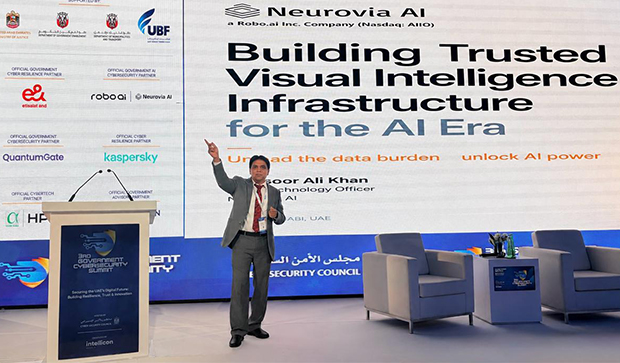
Abu Dhabi, UAE — June 9, 2026 — Robo.ai Inc. (NASDAQ: AIIO) today announced that its wholly-owned subsidiary, Neurovia AI, officially participated in The 3rd Government Cybersecurity Summit as an Official Government AI Cybersecurity Partner, showcasing the latest technological capabilities of its core architecture, NeuroStream™. Chief Technology Officer Mansoor Ali Khan delivered a keynote address titled “Building Trusted Visual Intelligence Infrastructure for the AI Era,” outlining the underlying data transformation required for the large-scale deployment of Physical AI.
The summit convened UAE government leaders, regulators, global cybersecurity experts, and technology innovators to share insights, present strategies, and promote secure digital growth. During the event, Neurovia AI’s NeuroStream™ visual data infrastructure platform garnered attention for its data reconstruction and highly efficient lossless compression capabilities under real-world operational loads.
In his keynote, Mr. Khan noted that the next decade of the artificial intelligence industry will be driven by underlying infrastructure and data evolution. To address the storage expansion, network transmission costs, and systemic security challenges caused by the exponential growth of video data, the NeuroStream™ architecture establishes a multi-layered defense matrix directly at the data source. This foundational design ensures the closed-loop circulation of critical national sensitive data within enterprise firewalls, providing solid technical support for localized data management and control while driving the transition of visual data architectures from human viewing to machine understanding. The summit further clarified Neurovia AI’s positioning as the core foundational layer within Robo.ai’s global strategy. The company is accelerating the commercial delivery of this technology across high-concurrency enterprise scenarios, including safety and security, autonomous driving, smart cities, and intelligent manufacturing, laying a solid foundation for the efficient perception and coordination of global smart machine networks.